
Pruning
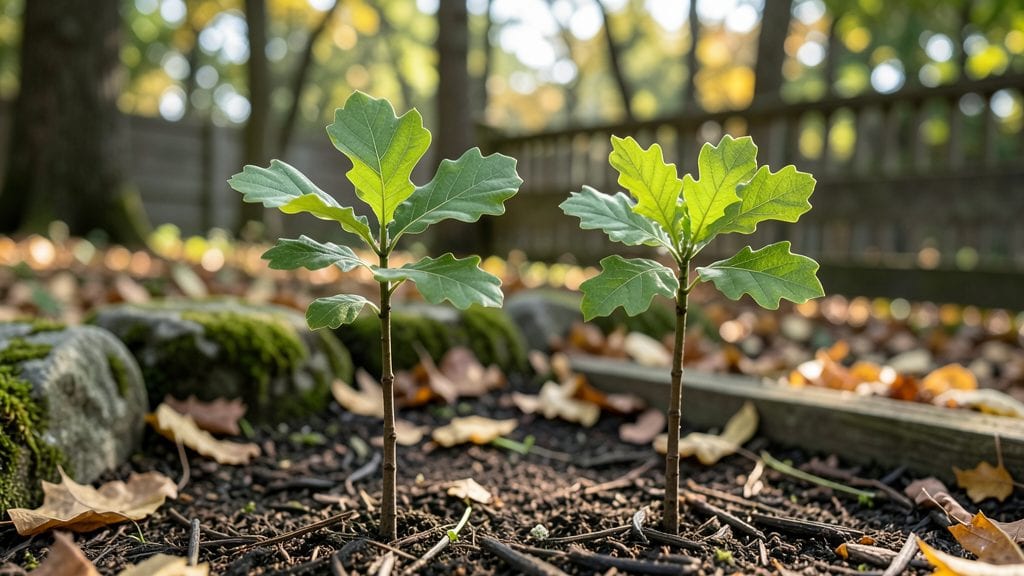
Mastering tree seedling identification by their leaves and bark saves you from years of guessing which sapling will thrive in your yard—before you waste time on the wrong species. winters.
The key is noticing tiny details—like whether leaves are lobed or smooth-edged, or if bark is fuzzy or ridged—that tell you exactly what you’re dealing with.
Start with leaf shape: a maple’s jagged edges or oak’s rounded lobes are dead giveaways, while pine needles grow in clusters of two or three. Then check the bark—smooth and gray for birch, deeply furrowed for beech, or even peeling like paper on sycamore.
These clues let you match seedlings to your climate and sunlight, so you’re not stuck with a tropical species that freezes in your first winter.
Once you master these basics, you’ll spot the right seedlings at nurseries or even wild patches in your neighborhood. Imagine transplanting a native oak instead of a weakling that’ll never grow tall—your yard’s future depends on getting this right.
The payoff? Stronger trees that fit your space and soil, with minimal pruning or replacement headaches later.
This works for both backyard planting and large-scale restoration projects. Whether you’re revamping a landscape or just want to know what’s sprouting in your flower bed, these tricks cut years off the learning curve. Let’s get those seedlings identified the right way.
Root Causes of Seedling Mix-Ups
Understanding why tree seedling identification can be tricky starts with recognizing the natural and human factors at play. Whether you're a gardener, landscaper, or conservationist, misidentifying seedlings often boils down to a mix of biological complexity and practical challenges.
Let’s break down the key reasons why this happens—so you can avoid them like a pro.
Many tree species share striking similarities in their early stages, making it nearly impossible to distinguish them by leaf shape or bark alone. Here’s why:
- Juvenile vs. Mature Traits: Seedlings often look nothing like their adult counterparts. For example, a sycamore seedling might resemble a maple until it develops its signature bark, while a white oak may mimic a red oak until its acorns mature.
This phenomenon, called heteroblasty, means you can’t rely on adult characteristics in young plants. - Convergent Evolution: Some species evolve similar features independently to adapt to the same environment.
A beech and birch might both have smooth bark and serrated leaves as seedlings, even though their mature forms differ drastically. - Leaf Mimicry: Certain species, like ash and boxelder, produce leaves that are nearly identical in shape, size, and venation.
Without flowers, fruit, or bark cues, telling them apart requires a trained eye—or a magnifying glass.
Actionable Tip: 🔍 Compare multiple growth stages—if possible, study mature trees nearby or consult a seedling identification key that accounts for juvenile traits.
Seedlings are essentially "babies" in the plant world, and like human infants, they don’t always show their full potential right away. Here’s how this affects identification:
- Bark Immature or Absent: Young trees often lack the distinctive bark patterns that make adult identification easier.
A paper birch’s white bark won’t appear until the tree is years old, leaving you with just leaves—and those might resemble a cherry or hawthorn. - Lack of Reproductive Features: Flowers, fruits, or seeds (like acorns or pinecones) are critical for accurate ID, but seedlings may not produce them for years.
Without these, you’re left guessing based on vague leaf shapes. - Variable Growth Conditions: A seedling’s appearance can shift based on sunlight, soil nutrients, or water availability.
A red maple grown in shade might have darker, smaller leaves than one in full sun, making it look like a sugar maple instead.
Pro Tip: ✨ Track growth over time—if you’re planting seedlings, monitor them for 1–2 seasons to spot emerging traits like bud scales, twig color, or early bark formation.
Even with the right tools, people often miss subtle but critical clues. Here’s how:
- Focusing on the Wrong Features: Many guides emphasize leaf shape or margin type (lobed, serrated, etc.), but seedlings can have inconsistent leaf patterns due to stress or genetics.
Overlooking twig arrangement (alternate vs. opposite) or bud shape can lead to mistakes. - Seasonal Blind Spots: Identifying seedlings in winter (when leaves are absent) relies heavily on bud scales, twig color, or bark texture—details many people skip.
A willow’s smooth, yellowish twigs might be mistaken for a birch if you ignore the lack of lenticels (porous dots on the bark). - Relying on Common Names: Terms like "sweetgum" or "elderberry" can vary by region, leading to confusion.
A hackberry seedling might be called "sugarberry" in some areas, while its leaves could be confused with a mulberry.
Key Takeaway: 📊 Use a dichotomous key (a step-by-step ID tool) to narrow down options systematically. Apps like iNaturalist or LeafSnap can also cross-reference visuals with expert databases.
Not all seedlings behave the same way across different climates or ecosystems. Here’s how location plays a role:
- Hybridization: In areas where species overlap (like oak hybrids in the Midwest), seedlings can inherit mixed traits, making identification a puzzle.
A swamp white oak × bur oak hybrid might have leaves that don’t match either parent. - Invasive Species Confusion: Non-native trees, like Bradford pear or autumn olive, often have seedlings that mimic native species.
Their aggressive growth can outcompete locals, but their leaves might resemble a hawthorn or serviceberry. - Microclimates: A pine seedling in a dry, sunny spot might look stunted and different from one in a moist, shaded forest.
Without context, you might misclassify it as a spruce or fir.
Field Tip: 🌡️ Note the habitat—where the seedling is growing (wetland, forest edge, urban lot) can narrow down possibilities. For example, alder seedlings thrive near water, while pine seedlings prefer dry, sandy soil.
Even experienced gardeners can struggle without the right resources. Common pitfalls include:
- Outdated Guides: Old field manuals may describe species that have since shifted ranges due to climate change or invasive species.
A 1980s guide might not account for emerald ash borer altering ash tree populations. - Poor Photography: Many online ID tools rely on blurry or poorly lit photos, making it hard to spot fine details like leaf base shape or hairiness on stems. - Ignoring Local Expertise: Regional botanists or arborists know which species are most likely in your area, reducing guesswork.
Skipping this step is like trying to diagnose a fever without considering the patient’s location.
Solution: 🎯 Cross-check with multiple sources—combine a field guide, a local university extension service, and citizen science apps like iNaturalist for consensus.
Sometimes, the origin of the seedling is the missing piece of the puzzle:
- Wind-Dispersed Seeds: Trees like maples and elms spread seeds widely, leading to seedlings in unexpected places.
A Norway maple seedling in a suburban yard might look identical to a native sugar maple until you examine the seedling’s growth habit. - Animal-Dispersed Seeds: Fruits eaten by birds (like serviceberry or hawthorn) can deposit seeds far from the parent tree, creating seedlings with unexpected neighbors. - Cultivar Confusion: Ornamental trees (e.g., dwarf cultivars of Japanese maple) may produce seedlings that revert to their wild-type traits, making them look like a different species entirely.
Action Step: 🌰 Trace the seed source—if you planted the seedling yourself, check the parent tree’s ID. If it’s wild, look for seed pods, cones, or animal activity nearby.
Quick Fixes for Seedling ID Struggles
Mistakenly misidentifying seedlings can lead to poor planting choices, wasted resources, or even unintended invasive species spreading. But don’t worry—with the right tools and techniques, you can turn confusion into confidence. Below, we’ll tackle common challenges in tree seedling identification and provide actionable solutions, from quick fixes to long-term prevention.
Problem: Some species (like oak vs. hickory or maple vs. ash) share leaf shapes, bark textures, or growth habits, making them hard to distinguish at the seedling stage.
How to Fix It:
- 🍃 Compare Leaf Arrangement & Venation
- Opposite leaves (growing directly across from each other, like maples) vs. alternate leaves (staggered along the stem, like willows).
- Check vein patterns: Pinnate (feather-like, e.g., walnut) vs. palmate (finger-like, e.g., maple).
- 🌲 Examine Bark Texture Early
- Young bark can reveal clues: Smooth and silvery (birch), furrowed or scaly (oak), or peeling in strips (sycamore).
- Use a magnifying glass if needed—some species have tiny hair-like structures or glandular dots.
- 📏 Measure Key Features
- Record leaf length/width ratios, seedling height, and stem diameter. Create a simple chart for comparison:
| Feature | Red Maple | Sugar Maple | White Oak |
|---|---|---|---|
| Leaf Shape | 3–5 lobes, serrated edges | 5 lobes, U-shaped sinuses | 7–9 rounded lobes |
| Bark at Base | Smooth, greenish | Smooth, grayish | Ridged, dark brown |
| Seedling Height (1 year) | 1–2 ft | 6–12 in | 8–15 in |
💡 Pro Tip: Take photos from multiple angles (top-down, side view, close-ups of bark/leaves) and compare them to a USDA Plant Database or local field guides.
Problem: Young seedlings (e.g., conifers or dormant deciduous species) may lack leaves, making identification nearly impossible.
How to Fix It:
- 🌲 Focus on Bud and Stem Clues
- Bud shape: Pointy (pine), rounded (spruce), or scale-like (fir).
- Needle arrangement: Clustered (pine) vs. single needles (spruce).
- Stem color: Reddish (dogwood), greenish (willow), or brown (oak).
- 🔍 Check for Dormant Leaf Scars
- Some species (like beech) leave horizontal scars on stems where leaves once attached. Count them to estimate age.
- 🌍 Use Location as a Hint
- Seedlings in wet areas might be willow, alder, or buttonbush.
- Dry, sunny slopes often host pine, juniper, or sumac.
🔥 Quick Fix: Dig 1–2 inches deep to check for root structure—taproots (oak) vs. fibrous roots (maple).
Problem: Non-native or invasive seedlings (e.g., autumn olive, Russian olive, or kudzu) can mimic natives, risking ecosystem harm.
How to Fix It:
- 🌿 Learn "Red Flag" Traits
- Autumn olive: Tiny white flowers in spring, red berries, smooth, hairless leaves.
- Mimosa (silky dogwood): Double-pinnate leaves (feather-like feathers) and thorny stems.
- Kudzu: Purple flowers in summer, heart-shaped leaves in groups of 3.
- 📋 Cross-Reference with Local Lists
- Check your state’s invasive species database (e.g., USDA Invasives) and compare seedlings to known offenders.
- 🌱 Remove Suspects Immediately
- Dig up and bag invasive seedlings to prevent spread. Do not compost them—burn or dispose of them in sealed trash.
✨ Prevention Tip: Source seedlings from reputable nurseries that sell native-only or regionally adapted species.
Problem: Seedlings change dramatically with seasons—what’s easy to spot in summer (leaves!) becomes a puzzle in winter (bare branches).
How to Fix It:
- 🍂 Winter Identification Tricks
- Bud clusters: Tight clusters (maple) vs. single buds (birch).
- Branch patterns: Layered (oak) vs. smooth (beech).
- Leaf litter: Collect fallen leaves to compare with current seedlings.
- 🌿 Spring/Summer Boosters
- Watch for flowering time (e.g., dogwood blooms early spring, sumac in late summer).
- Note fruit/seeds: Acorns (oak), samaras (maple), or pinecones (conifers).
🎯 Pro Tip: Tag seedlings in spring with species guesses, then revisit in fall to confirm with leaf development.
Final Reminder: When in doubt, consult a local arborist or university extension office—they often offer free seedling ID workshops or hotlines. With practice, you’ll start recognizing patterns faster than you think! 🌳🔍
Frequently asked questions
How can I tell the difference between a maple and oak seedling?
Check the leaf shape first: maple seedlings have palmate leaves (5 lobes spreading from one point), while oak seedlings feature rounded lobes with bristle-tipped edges. Maple leaves also grow in opposite pairs along the stem, whereas oak leaves are alternate.
What should I do if I can't see leaves on my seedling?
Focus on bud shape and stem texture—pine seedlings have pointy buds in clusters, while birch seedlings show smooth, white bark even when young. Examine the root structure too: oaks develop taproots, while maples have fibrous roots.
Are there apps that help identify tree seedlings?
Yes! Try LeafSnap or iNaturalist—both use AI to match photos of leaves, bark, and buds to species databases. For offline use, download the USDA Plants Database app or consult a regional field guide from your state's extension service.
Why do some seedlings look different in winter?
Without leaves, focus on bud scales (maples have pointed buds, while birches have rounded ones) and stem color. Evergreens like pine or spruce keep needles year-round, but their needle arrangement (clusters vs. single needles) reveals their identity.
How do I know if a seedling is invasive?
Look for red flags like aggressive growth, thorny stems (mimosa), or smooth, hairless leaves (autumn olive). Check your state's invasive species list—many have distinct traits (e.g., kudzu has heart-shaped leaves in groups of 3).